
Missing Teeth and Bone Loss: How Bone Grafting and Sinus Lifts Rebuild Your Foundation
A missing tooth is not a static problem. The jawbone that once held it starts to shrink within months, and that shrinking is the reason many patients are told they "do not have enough bone" for an implant. Here is why the bone disappears, how quickly, and how bone grafting and sinus lift surgery rebuild what was lost so an implant has a solid foundation.
You lost a back tooth two years ago. It was cracked, the dentist took it out, and honestly you have not missed it much. You chew on the other side. Nobody can see the gap.
Now you are ready to replace it, and the consultation takes a turn you did not expect. The 3D scan shows there is not enough bone left for an implant. The tooth is gone, and so, quietly, is much of the bone that used to hold it.
This surprises almost everyone. It should not, because it is one of the most predictable things that happens in the mouth. The good news is that it is also one of the most fixable.
Why the Jawbone Shrinks After a Tooth Is Lost
The bone that holds your teeth is called alveolar bone, and it exists for one reason: to anchor tooth roots. Every time you bite and chew, the root transfers load into that bone through the periodontal ligament, and the bone responds by staying dense and full. Remove the tooth and the signal stops. The body reads unused bone as unnecessary and begins to resorb it.
This is not a slow drift over decades. A frequently cited 12 month study by Schropp and colleagues, published in the International Journal of Periodontics and Restorative Dentistry, found that the width of the ridge shrank by about 50 percent in the first year after a single extraction, and that roughly two thirds of that loss occurred in the first three months. A 2012 systematic review in Clinical Oral Implants Research pooled the available human studies and put the horizontal loss at 29 to 63 percent and the vertical loss at 11 to 22 percent within six months, with the fastest change in the first three to six months.
Width goes first, and it goes from the cheek side, where the bone plate is thinnest. That matters for implants because an implant needs bone on all sides of it, not just underneath. A ridge that looks fine on an X-ray can be too narrow to hold an implant of the right diameter.
Bone is also lost for reasons other than extraction. Advanced gum disease dissolves the bone around teeth that are still in the mouth, which is why the warning signs of gum disease deserve attention long before a tooth feels loose. Years of wearing a denture that rests on the gums, trauma, and infection around a failing tooth all remove bone as well.
The Upper Back Jaw Has a Second Problem: The Sinus
Above your upper molars and premolars sits the maxillary sinus, an air filled space lined with a thin membrane. The floor of that sinus and the roots of your upper back teeth are close neighbors. Sometimes the roots push up into the sinus floor itself.
When an upper back tooth is removed, the ridge shrinks from below, as it does everywhere else. At the same time, the sinus expands downward into the space the root left behind. Radiologists call this pneumatization. A 2008 study in the International Journal of Oral and Maxillofacial Implants measured the sinus floor moving down by roughly 2 millimeters on average after posterior extractions, with the largest change behind second molars and more than 5 millimeters where the sinus floor had curved around the roots.
Bone loss from below and sinus expansion from above squeeze the available bone from both directions. That is why the upper back jaw is the single most common place a patient hears that an implant is not possible without preparation first. It is also exactly the situation a sinus lift was designed to solve.
What Happens If You Simply Leave the Gap
Delaying replacement is understandable. It is also the main reason the eventual treatment becomes more involved.
Neighboring teeth begin to tip and drift into the open space, and the tooth that used to bite against the missing one can over erupt, since nothing stops it. The bite changes, which can concentrate force on other teeth and make future restorative work harder to fit. As bone continues to thin, the cheek or lip in that area loses support, which is part of why people with many missing teeth develop a sunken look around the mouth.
Tooth loss remains common. Using 2015 to 2018 national survey data, the CDC reported that 12.9 percent of adults aged 65 and over had lost all of their teeth, rising to 17.8 percent among adults 75 and over. The trend is improving, but the underlying pattern is the same at any age: the longer a gap stays open, the more bone is gone when you finally decide to fill it.
None of this means an implant is off the table. It means the foundation usually has to be rebuilt first.
How Bone Grafting Rebuilds the Ridge
A dental bone graft places bone or bone substitute material where the ridge has thinned or collapsed, so that your body can grow new bone through it. The graft is a scaffold. Your own cells do the actual rebuilding.
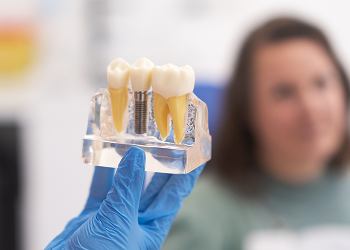
There are several categories of graft material, and each has a role. Autogenous bone is taken from another site in your own body, often the chin or back of the jaw. It contains living cells and has long been considered the gold standard, at the cost of a second surgical site. Allograft bone comes from screened human donors through a tissue bank and avoids a second site. Xenograft is processed bovine bone that leaves a mineral framework the body slowly replaces. Synthetic materials such as hydroxyapatite and calcium phosphate provide a similar framework without any donor. Your periodontist will explain which option fits your case; there is no single right answer for everyone.
The procedure itself is more routine than it sounds. After the area is numbed, a small incision in the gum exposes the ridge, the graft material is placed and shaped, and the gum is closed over it. In guided bone regeneration, a thin membrane is placed over the graft to keep gum tissue from growing into the space before bone can. Depending on the case, biologic aids such as platelet rich fibrin made from your own blood, or enamel matrix proteins, may be added to support healing. A follow up visit within about ten days lets us confirm the site is healing as expected. More detail is on our bone grafting page.
Grafting is used in three main situations. Ridge preservation places a graft into the socket immediately after an extraction, which limits the rapid collapse described above and is the simplest way to keep the implant option open. Ridge augmentation rebuilds a ridge that has already lost width or height. And a graft may be placed at the same visit as an implant to fill a small gap around it.
How a Sinus Lift Creates Room in the Upper Jaw
A sinus lift, also called sinus augmentation, adds bone between the floor of the sinus and the top of the ridge in the upper back jaw. It does not touch the sinus itself in the way patients sometimes imagine. The sinus membrane is lifted, not opened.
In the traditional lateral window approach, a small opening is made in the side wall of the jaw above the premolars or molars. Through that window, the membrane lining the sinus is gently raised, and the space created beneath it is filled with graft material. The incision is closed and the bone matures over the following months. Where only a few millimeters of extra height are needed, a crestal approach can sometimes be used instead, working up through the implant site itself and avoiding the side window.
The research base is large. A 2008 systematic review in the Journal of Clinical Periodontology examined 48 studies covering more than 12,000 implants placed after lateral window sinus lifts and found a three year implant survival rate of about 90 percent, with the best results when rough surface implants were used and the window was covered with a membrane. The most common surgical complication was a small tear in the sinus membrane, seen in roughly one in five procedures across the studies; these are usually managed during surgery and rarely change the outcome. Graft failure itself was uncommon, under 2 percent.
Our sinus lift surgery page covers the procedure and recovery in more detail, including the fact that many patients find the discomfort afterward milder than they feared.
Timelines: What to Expect and When
Rebuilding bone takes patience, because the goal is living bone, not just filled space.
After a bone graft, the American Academy of Periodontology describes a maturation period of roughly four to twelve months before an implant is placed, and the same range applies after a sinus lift. Smaller grafts sit at the short end; larger reconstructions sit at the long end. In some cases, when enough native bone exists to hold an implant stable, the implant can be placed at the same visit as the graft or sinus lift, which removes a healing stage entirely.
There is also a window on the other side. Grafted bone that is never loaded by an implant slowly begins to shrink again, so once a site has healed, implant placement is generally planned within the following several months rather than left open ended.
The first week after either procedure looks like most oral surgery: some swelling, mild bruising, soft foods, and a short course of medication. After a sinus lift you will be asked not to blow your nose forcefully or sneeze with your mouth closed for a couple of weeks, to protect the lifted membrane. Smoking is the single biggest controllable risk to a graft, and we will talk about that honestly before scheduling.
Is Grafting Always Necessary?
No, and a good consultation should say so when it applies.
Some patients who assume they need a sinus lift have enough bone for a shorter implant, and the evidence comparing short implants with sinus lifts in borderline cases is still developing. Some patients have plenty of bone height and only need a small graft for width. And when a tooth has not yet been removed, placing a ridge preservation graft at the time of extraction often prevents the larger procedure later.
What determines the plan is measurement: a cone beam 3D scan showing bone height, width and density, the position of the sinus and nerves, your medical history, and the restoration you actually want at the end. If you are weighing options, our overview of dental implants for one tooth, several, or a full arch is a useful place to start.
This article is general educational information about periodontal and implant treatment. It is not a substitute for an examination, diagnosis and treatment plan from a licensed dental professional.
Frequently asked questions
- How do I know if I have lost bone where a tooth is missing?
Often you cannot tell by looking or feeling, because gum tissue covers the ridge and hides its shape. A cone beam 3D scan measures the height and width of the bone precisely and shows the position of the sinus and nerves, which is why we take one before planning any implant.
- Does a bone graft or sinus lift hurt?
The procedure is done with local anesthesia, and sedation dentistry is available for anxious patients. Afterward, most people describe pressure, swelling and soreness for a few days that responds to over the counter or prescribed medication. Sinus lift patients often say the recovery was easier than they expected.
- How long after a bone graft can I get my implant?
Typically four to twelve months, depending on the size of the graft and how your bone responds. In select cases the implant is placed at the same time as the graft. Dr. Bergens will give you a specific timeline after reviewing your scan.
- Where does the graft material come from?
Options include your own bone, donor bone from a tissue bank, processed bovine bone, and synthetic bone substitutes. Each has advantages, and the choice depends on how much bone is needed and where. We will walk through the options with you rather than defaulting to one.
- I lost a tooth years ago. Is it too late for an implant?
Rarely. Bone loss makes the process longer, not impossible. Most sites that have lost bone can be rebuilt with grafting, a sinus lift, or both, and then restored with an implant.
- Will insurance cover bone grafting or a sinus lift?
Coverage varies by plan and by whether the procedure is coded as periodontal or implant related. Our team can review your benefits and submit a predetermination so you know where you stand before treatment begins.
Talk it through with a specialist
Dr. Bryan M. Bergens is a board-certified periodontist serving Daytona Beach and Palm Coast. A consultation replaces guesswork with measurements.