
The Warning Signs of Gum Disease You Should Not Ignore
A little blood in the sink is easy to explain away, and that is exactly why periodontal disease so often goes unnoticed until it is advanced. Here are the warning signs people dismiss, the ones they miss entirely, the real difference between gingivitis and periodontitis, and what actually happens at a periodontal evaluation.
There is a faint pink swirl in the sink after you brush. You notice it, rinse it away, and decide you were pressing too hard. The next morning it happens again. By the end of the week you have stopped registering it, the way a dashboard light becomes part of the dashboard.
That quiet negotiation, repeated over months, is how most periodontal disease goes unnoticed. Not because people are careless, but because the early signals are small, painless, and easy to explain away. They are also specific, and once you know what you are looking at, deciding whether to get it checked gets much simpler.
The Signs Most People Talk Themselves Out Of
Start with the ones that get dismissed, because these are the ones that show up first.
- Bleeding when you brush or floss. The American Academy of Periodontology lists bleeding while brushing, flossing, or eating hard food as a sign of gum disease. Healthy tissue does not bleed when it is cleaned properly, and brushing harder is not the fix.
- Gums that look puffy, shiny, or a deeper red than usual. Inflammation is often uneven, so compare the tissue around one tooth to its neighbors.
- Tenderness that comes and goes. People blame stress or a new toothpaste. Sometimes it is inflammation flaring and settling.
- Bad breath that returns quickly. Breath that comes back within an hour of brushing is not morning breath. A toothbrush does not reach bacteria below the gumline.
- Teeth that look longer than they used to. People read this as normal aging. Often it means the gumline has migrated, which is gum recession, and that can signal lost support underneath.
- New sensitivity at the gumline. Exposed root surface makes cold air and water register in a way they never did before.
None of these alone is a diagnosis. Any of them lasting more than a week or two is worth having checked.
The Signs That Mean It Has Been There a While
These show up later, and they matter more.
- Gums that have pulled away from the teeth, so a tooth sits in a trench rather than a snug collar.
- Pus between gums and teeth, or a bad taste that keeps returning to the same spot.
- A tooth that feels loose, or that moves slightly under your tongue.
- Teeth that are drifting or flaring, creating gaps that were not there in old photographs.
- A bite that feels different, or a partial denture that no longer seats the way it did.
- Discomfort when chewing on one particular tooth.
If that list sounds familiar, it is information, not a verdict. Periodontal disease is measurable and manageable, and knowing where you stand is what changes the outcome.
Why Gum Disease Usually Does Not Hurt
This is the most useful thing to understand about the condition, and the reason people arrive late. Periodontal disease is often silent, and symptoms may not appear until the advanced stages. A cavity that reaches the nerve produces a toothache within days. Periodontal inflammation lives in the tissue and bone around the tooth, and it can continue for years without producing pain that makes anyone pick up a phone. When pain does arrive, it usually signals an abscess or a tooth that has already lost significant support.
So the absence of pain tells you very little. Bleeding, swelling, recession, and odor are the early language of this disease. Pain is the late translation.
Gingivitis and Periodontitis Are Not the Same Problem
These two words get used interchangeably, and the difference between them is the most important distinction here.
Gingivitis is the mildest form of gum disease. The gums are inflamed, red or swollen, and they may bleed easily, but the bone and the attachment holding the tooth in place have not been damaged. The AAP is clear that gingivitis is reversible with professional treatment and good care at home. Caught here, this is a problem that genuinely goes away.
Periodontitis is what can develop when gingivitis is left alone. The inflammation moves below the gumline, the attachment between gum and tooth breaks down, and bone around the tooth is lost. The CDC states plainly that periodontitis cannot be reversed, but that it can be slowed down and managed. Lost bone does not grow back on its own.
That distinction is where a common misunderstanding lives. Rinses, saltwater, and better brushing are genuinely useful for gingivitis. What they cannot do is remove hardened deposits from root surfaces below the gumline, or rebuild attachment that is already gone. If home care has not settled the bleeding after a couple of weeks, that is a sign to get measured, not to try a different rinse. Professional cleanings and preventive care exist because a toothbrush has limits.
Periodontists describe diagnosed periodontitis using the 2017 classification from the AAP and the European Federation of Periodontology. It assigns a stage from I through IV based on how much damage has occurred and how complex it is to treat, and a grade from A through C based on how fast it appears to be progressing. In plain terms, the stage says where you are, the grade says how quickly you got there.
How Common This Is, and What Raises Your Risk
Using NHANES data from 2009 to 2012, researchers found that about 46 percent of U.S. adults aged 30 and older had periodontitis, with 8.9 percent having the severe form. Among adults 65 and older, from that dataset, prevalence was roughly 68 percent. A later analysis pooling 2009 to 2014 data reports 42.2 percent for adults 30 and older, so cited figures vary by dataset.
Either way, it is common, and more so with age. Several things raise individual risk:
- Smoking and tobacco use, which the AAP calls possibly the most significant risk factor in the development and progression of periodontal disease.
- Diabetes, particularly when blood sugar control is inconsistent.
- Genetics. Some people are more susceptible even with good home care, so family history is worth mentioning at an exam.
- Medications. Hundreds of common drugs reduce saliva flow, and saliva is part of the mouth's defense. Certain anticonvulsants, immunosuppressants, and calcium channel blockers can also cause gum tissue overgrowth, which makes cleaning harder.
- Hormonal changes, including pregnancy and menopause, which can make gum tissue more reactive.
- Stress, poor nutrition, obesity, and grinding or clenching, which the AAP includes among contributing factors.
If two or three of these describe you, the case for regular periodontal care gets stronger, whatever you see in the mirror.
What the Evidence Actually Says About Gum Health and Overall Health
You have seen the headlines connecting gum disease to heart disease, diabetes, and pregnancy complications. Here is the careful version, because the careless version is everywhere.
Researchers have consistently found associations between periodontal disease and several systemic conditions. With diabetes, the AAP notes the relationship appears to run in both directions: people with diabetes are more likely to have periodontal disease, and periodontal disease may make blood sugar harder to control. With cardiovascular disease, studies suggest periodontal disease may increase risk, with inflammation as the proposed explanation, but a causal relationship has not been established. An association with adverse pregnancy outcomes has been recognized since the 2000 Surgeon General's report, which called for more research on causation.
The American Dental Association puts it plainly: associations do not imply causation and may be influenced by confounding factors. Treating gum disease has not been shown to prevent heart attacks or preterm births, and no one should promise that it will.
What is fair to say is that periodontal disease is a chronic inflammatory infection, and your physician and your periodontist should each know what the other is seeing. That is reason enough to take it seriously.
What Happens at a Periodontal Evaluation
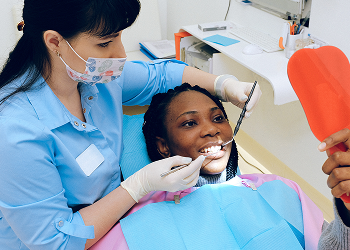
For most people, the unknown is scarier than the appointment. The AAP recommends an annual comprehensive periodontal evaluation, which looks at your teeth, your plaque, your gums, your bite, your bone structure, and your risk factors. It covers:
- Probing depths. A small marked instrument gently measures the space between gum and tooth at several points around each tooth. Shallow readings that do not bleed are the goal. Deeper readings suggest lost attachment.
- Bleeding on probing. Whether a site bleeds when measured is recorded, because it is a clear indicator of active inflammation.
- Recession. How far the gumline has moved, measured rather than estimated.
- Mobility and furcation. Whether teeth move, and whether bone loss has reached the area between the roots of multi-rooted teeth.
- Radiographs. X-rays show the bone level, which cannot be assessed by looking.
- Medical and medication history, including smoking, diabetes, and anything affecting saliva or gum tissue.
The result is a chart of numbers rather than an impression, and numbers can be compared against next year's.
Treatment, if any is needed, follows the findings. It ranges from more frequent professional cleaning, to scaling and root planing to clean root surfaces below the gumline, to laser gum surgery or conventional surgery in more advanced cases, to procedures such as the Chao Pinhole Surgical Technique where recession is the concern. If you have already been told you need surgery, our guide to LANAP laser gum surgery covers that in depth. Nothing is decided at the evaluation itself.
When to Stop Waiting and Get Seen
Call and schedule an exam if any of the following is true:
- Bleeding has continued more than two weeks despite careful brushing and flossing.
- Your gums are receding, or a tooth looks longer than its neighbor.
- Any tooth feels loose, or your bite has changed.
- There is pus, a recurring bad taste, or persistent bad breath.
- You smoke, have diabetes, or have a family history of tooth loss from gum disease.
- It has been more than a year since anyone measured your gums.
Waiting rarely improves the numbers. Earlier attention generally means simpler care, and it protects the option of keeping your own teeth rather than replacing them with dental implants later.
This article is general information and is not a substitute for an examination and diagnosis by a licensed dental provider.
Frequently asked questions
- Is it ever normal for gums to bleed when I brush?
Healthy gum tissue generally does not bleed during routine brushing or flossing. Occasional bleeding when you first resume flossing can happen as inflamed tissue settles, but bleeding that continues beyond a week or two is worth having evaluated rather than accepted as normal.
- Can gum disease go away on its own?
Gingivitis, the earliest and mildest form, is reversible with professional treatment and consistent home care. Periodontitis is different. Once attachment and bone have been lost, the CDC notes the condition cannot be reversed, though it can be slowed and managed. That is why the timing of the first exam matters, and why scaling and root planing is often the first step once disease is past the gingivitis stage.
- Does gum disease always cause bad breath?
No. Persistent bad breath is a common sign, but plenty of people with periodontal disease have breath they consider normal. Breath alone is not a reliable test.
- How do I know whether I have gingivitis or periodontitis?
You cannot tell from the mirror, because the difference is whether attachment and bone below the gumline have been lost. It is determined by probing measurements combined with X-rays, which is exactly what a periodontal evaluation is for.
- Do I need a referral from my dentist to see a periodontist?
You are welcome to schedule directly. Many patients come on referral from their general dentist, and many contact us on their own after noticing a symptom. If you have a dentist, we are glad to coordinate with them.
- I have not been to a dentist in years and I am embarrassed. What should I expect?
You will not be lectured. This is common, and the appointment is a measurement and a conversation, not a judgment. If dental anxiety has kept you away, tell us when you call and ask about sedation dentistry options.
Talk it through with a specialist
Dr. Bryan M. Bergens is a board-certified periodontist serving Daytona Beach and Palm Coast. A consultation replaces guesswork with measurements.